
The work is never done. It just repeats.
Ask any parent why they’re tired and you’ll rarely hear about one big thing. It’s the same small things, over and over.
The Sunday reset. The lunchboxes. The Monday meal plan built from a blank page. The inbox you scan every few days for the one school email with a date in it. None of it is hard. That’s almost the point. It’s not hard, it’s just constant.
The part nobody counts
When we talk about the mental load, we usually picture the moment something gets dropped — the missed form, the double-booked Saturday. But most of the load isn’t the things that fall through. It’s the things you catch, every single time, because catching them is now your job.
You don’t plan dinner once. You plan it every week. You don’t clear the to-do list once. You clear it, and it fills back up, and you clear it again. The work doesn’t end because it was never a project. It’s a loop.
Why loops are so heavy
A one-time task has an ending. A loop doesn’t. That’s what makes recurring work feel different from a to-do list, even when each individual task is small.
It also doesn’t fully hand off. You can ask your partner to plan meals this week, but next week the job quietly lands back on whoever remembers it needs doing. Recurring work has a way of returning to the person who’s been holding it, because they’re the one who knows it’s time.
So you keep holding it. Not because the tasks are large, but because remembering to do them, on schedule, forever, is its own kind of work.
What it costs
Your attention! Part of you is always tracking the calendar of recurring jobs — what’s due this week, what’s slipping, what you’ll need to redo on Sunday. It’s a background process that never quits.
Over time, that’s what makes a full life feel heavy instead of just full. Not the big events. The quiet certainty that the same work is coming back around, and it’s yours. Most people carrying it have never thought to ask whether something could just do the parts that repeat.
What changes when the loop runs itself
Maple is the operating system for modern families. The calendar, the tasks, the meals — the whole coordination layer, shared across the household. Today it does something new: it does the recurring work for you.
That’s Routines. You set a schedule — daily, weekly, monthly, or quarterly — and Maple handles the job from then on.
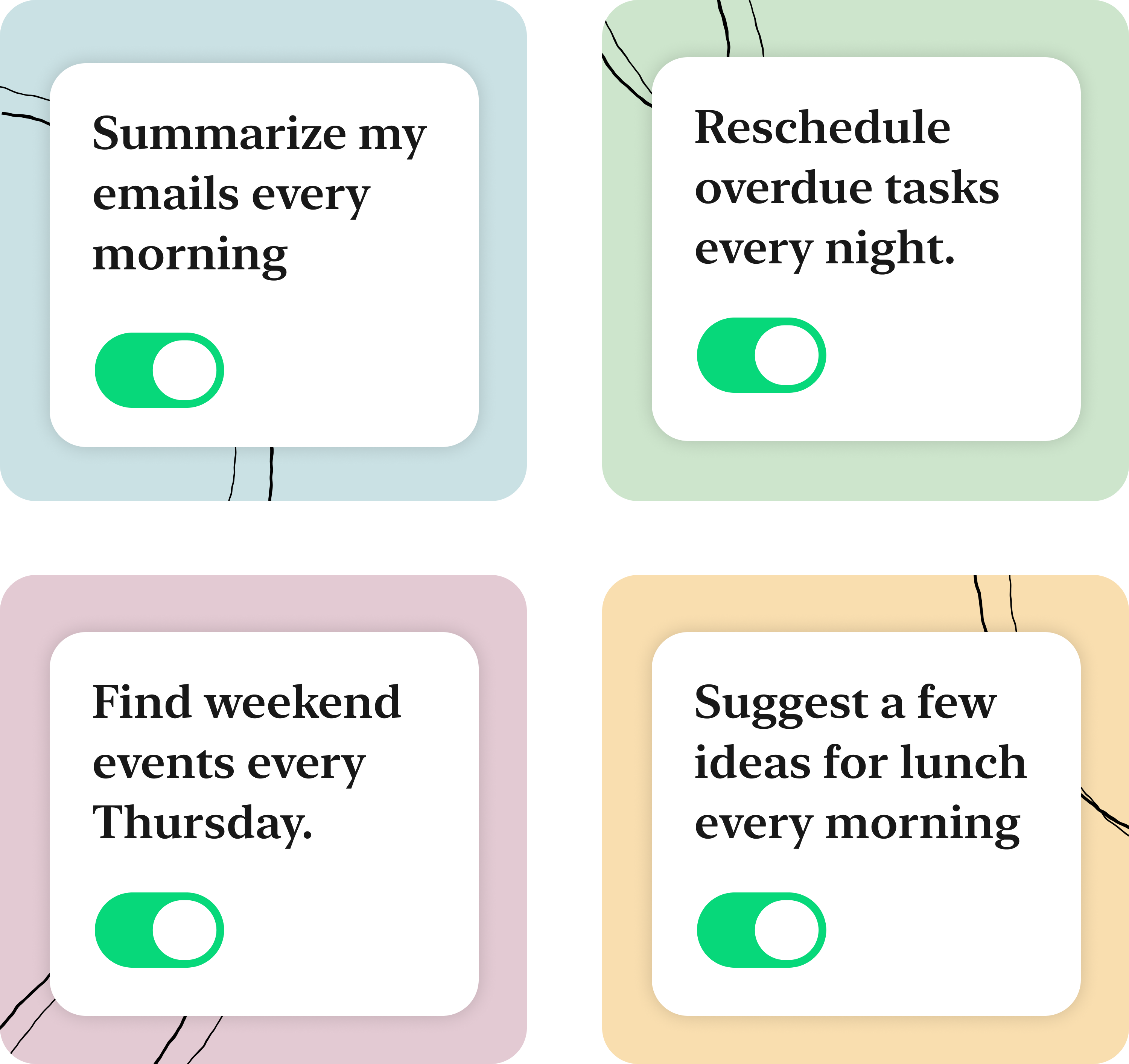
Tell Maple to move your unfinished to-dos into next week every Sunday at 7pm, and it does, without being asked again. Tell it to watch your inbox for events, and it adds them to your calendar before you’ve read the email. Tell it to plan the week’s meals at a set time, and Monday stops starting with a blank page.
You set it up once. After that, it’s not on your list anymore. It’s on Maple’s.
A reactive tool waits for you to open it and do the work. A routine does the work and tells you it’s done. One is a place you go to keep up. The other is something that keeps up for you.
Routines get more useful the more your family’s Maple has to work with. The fuller your calendar, tasks, and meal plan, the more Maple can take on, and the more of your week quietly runs itself.
Maple is the operating system families already run on. Routines is what comes next: not another thing to check, but a set of jobs you can finally stop carrying. The reset that happens without you. The inbox that sorts itself onto the calendar. The week that’s already planned when you sit down on Monday.
If you’re the one who’s been consistently carrying the load, you should be able to set it down.
The more your family uses Maple, the more it takes off your plate. Try it free at growmaple.com
Related articles



Ready to get your family organized?
Bring clarity and calm to everyday family planning with one shared space for emails, events, tasks, and meal plans.