
Family First in 2026
Building a Family First value system in the workplace. Open-sourcing our Family First playbook on how we work at Maple.
Are you setting your workforce up for success at home and in the workplace?
At Maple, we are obsessed with (putting your) Family First. It is our core company principle and our #1 company value.
Most companies put a huge emphasis on investing in company culture, but at Maple we believe it is our values that establish and protect our culture and vision. In this case, recognizing that you:
• Need to be there for your family
• Should not be penalized for being there for your family (actually should be celebrated)
• Family is your life's work, your “9–5” is not.
And maybe the most unpopular take that I can’t stress enough to my teammates at Maple: “I will not be at your funeral, but your kids will be. Their needs are the priority.”
Does this make me a bad CEO? Doubtful. Does it make me an honest leader? I believe so. Most importantly, does it make Maple a special place for parents to work? It does, and it shouldn’t.
Few things are truly time-sensitive, and when they are, our team respects and ensures it becomes the priority. When executives treat everything as a time-sensitive forcing function, it desensitizes any true time hierarchy and urgency. Even more, it puts unnecessary pressure to divest time with your kids, which is truly finite.
Our goal in open-sourcing our internal playbook in 2026 is to make more companies family-forward and to establish a better value system for working parents to make an impact in their professions while doing their life’s work at home.
We’ve built a new version of “work hard, play harder” that looks more like “be focused, be more present.”
At Maple, we believe these are the most important investments in establishing a “Family First” value system — and in turn, a Family First culture that supports working parents.
Offering Remote or Hybrid
Remote/hybrid offerings are likely the #1 Family First investment you can make as a company. The less time commuting, the better.
There are a lot of vocal advocates for return-to-office, but many companies are figuring out how to hire best-in-class talent, shape young talent, innovate, and grow remotely.
Why does this investment matter so much?
Ask yourself:
How can a parent drop their kids off at school (8:30–9 a.m., depending on school) and pick them up (12:45–3:05)? How can they get their kids to practice or activities? How can they do breakfast with their kids and still make dinner if there’s a one-hour commute?
The answer is simple: they can’t. These are the difficult questions that force many parents — especially mothers — to stop working altogether because they can’t abandon their care responsibilities.
Forcing a return-to-office policy creates one of the least Family First workplace environments imaginable, and I would go as far as calling it an anti-Family-First policy.
In a remote environment, you can ditch long commute times to participate in drop-off and pick-up, and you can work while your children are at practice or home from school. You can be an active member of the workforce and a primary caregiver.
Suggestions & Best Practices for Moving Your Office to the Cloud
Slack: Family-friendly Slack practices
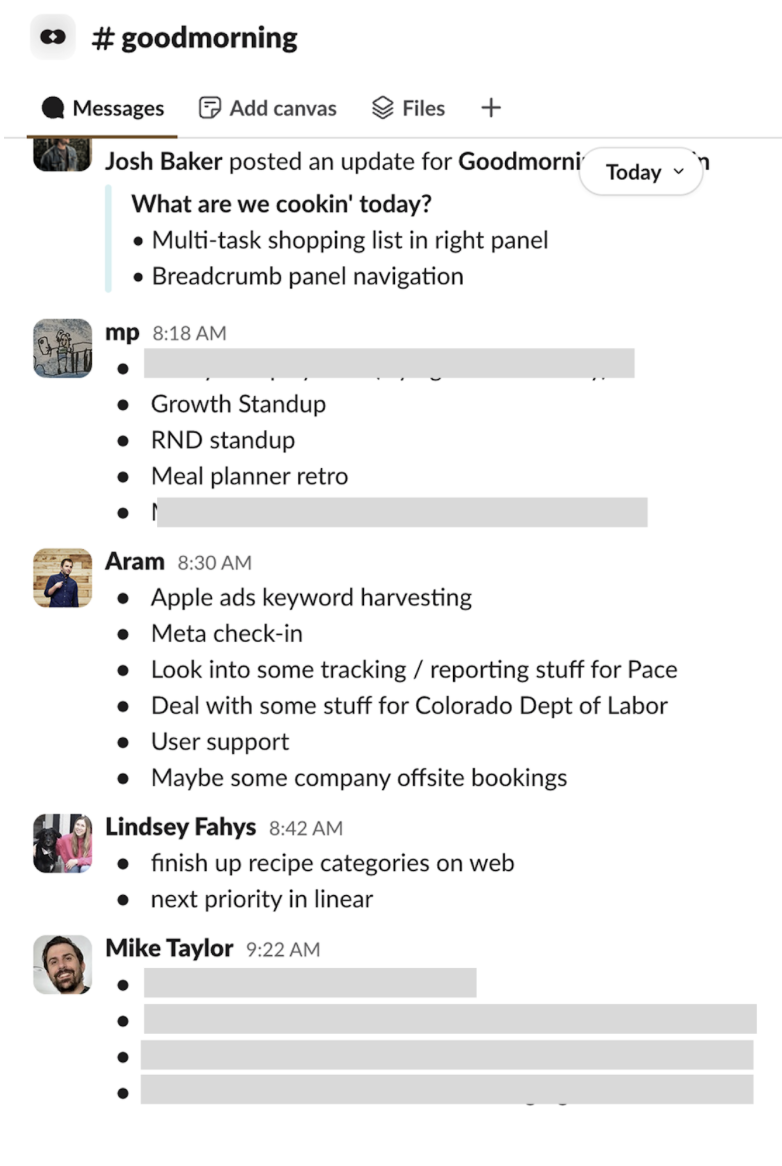
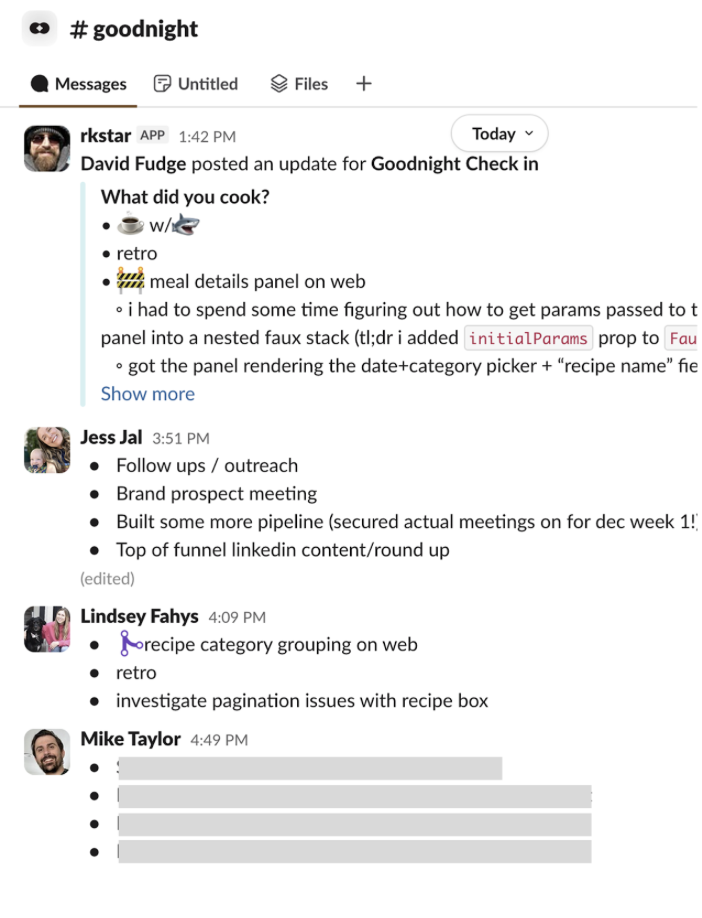
We use a #goodmorning channel for a company-wide virtual standup — letting teammates know you’re online and what you’re tackling today.
We also use a #goodnight channel — an end-of-day ritual that signals you’re signing off and may be slow to respond.
Huddles:
We encourage jumping on a Huddle instead of long DM threads to maximize facetime and pairing opportunities.
(Family) Flexibility & Time Ownership: 9–5 No Longer Works
Why?
9–5 made sense when the majority of households had one parent in the workforce. Today, most households are dual-working families. Just like in-person vs. remote, shifting from 9–5 to flexibility unlocks a parent’s ability to be active at work and at home.
At Maple, we operate under Family Flexibility.
What does that look like for a remote team across time zones?
• Everyone attends their team’s morning standup.
— Growth: 9:15 a.m. PST
— R&D: 10:00 a.m. PST
• Company-wide end-of-week check-in at 12:00 p.m. PST
• Heavy reliance on async work
• People attend family moments freely and make up time later
• Some start early, some work after bedtime
Our hope: You never miss a kid’s event or life moment. When it’s normalized at work, there’s zero resentment, and full trust batteries.
We Host 1 Annual Onsite Per Year
It’s “strongly encouraged,” not mandatory.
We meet as an entire company for three days to align on goals, workshop roadmap and product comms, improve how we work, and — most importantly — spend quality time together.
It may be our least “Family First” mandate, but the trust it builds is what allows every other remote and flexible practice to work.
Parent-Friendly Company Events (aka Skip the 5 p.m. Happy Hours)
Parents can’t easily attend 5 p.m. happy hours — dinner, bedtime, and caregiving routines make that impossible.
We host events like our virtual Holiday Trivia celebration at 12 p.m. PST, not on parents’ family time. It’s inclusive and celebrates during work hours.
Normalize Kids in the Background
It’s not every day, but it is normal to hold a child on your lap during a meeting or have a kid interrupt mid-conversation.
Why penalize that?
Why not embrace it?
If it’s happening, it’s happening because that child needs their parent. Let your people do their life’s work.
My sons often sit in my office and color while I work — and everyone at Maple has seen them on my lap.
Establish Transparency in Working Relationships
Respect these truths:
• You are teammates — not a family.
• You share a mission — you do not share a home.
Related articles


Ready to get your family organized?
Bring clarity and calm to everyday family planning with one shared space for emails, events, tasks, and meal plans.